


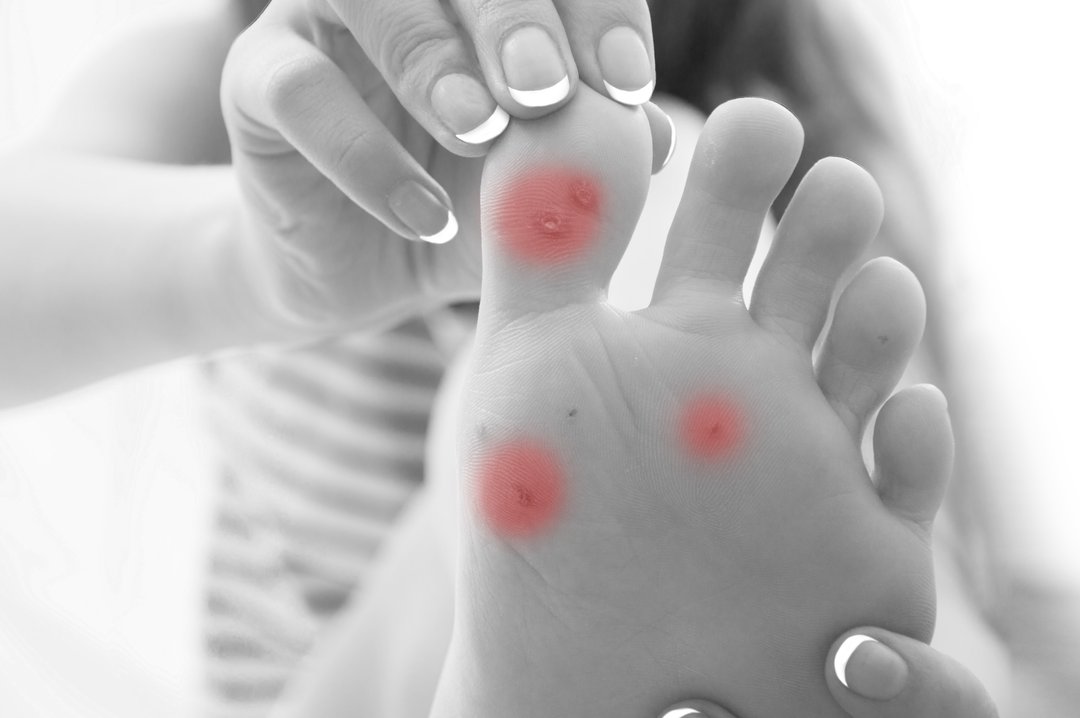
Why Won’t My Verruca Go Away?
Why Won’t My Verruca Go Away?
Verrucae are often dismissed as a minor nuisance. For some people, they are. A small verruca may appear, cause very little trouble and eventually disappear on its own.
But for others, verrucae can become surprisingly persistent.
At The London Podiatry Centre, we regularly see patients who have had the same verruca for months or even years. Some have tried acids, freezing treatments, pharmacy products and home remedies with little or no success.
So why do some verrucae disappear while others seem determined to stay?
What actually is a verruca?
A verruca is a viral infection of the skin caused by certain types of the human papillomavirus, or HPV.
It is essentially the same type of skin infection as a wart on the hand. On the sole of the foot, however, the pressure of standing and walking often pushes the lesion inwards, making it appear flatter and sometimes causing it to resemble a corn.
That is why correct diagnosis matters. A corn is caused by pressure and friction, whereas a verruca is caused by a virus.
Why can verrucae be so stubborn?
The answer often lies with the immune system.
The body is capable of recognising HPV and clearing the infection naturally, which is why verrucae often disappear spontaneously in children.
In adults, however, they can be much more persistent.
HPV is particularly good at remaining relatively unnoticed within the outer layers of the skin. In some people the immune system eventually recognises the infection and removes it. In others, the virus can remain for years.
This is also why there is no single treatment that is right for every verruca.
What if I have already had my verruca frozen?
This is something we hear very frequently.
Patients often tell us that they have already “tried freezing”, but not all cryotherapy treatments are necessarily the same.
Liquid nitrogen is approximately −196°C and, when applied effectively, it damages HPV-infected cells, affects the tiny blood vessels supplying the lesion and creates an inflammatory response that can help draw the immune system’s attention to the virus.
Preparation is important too. Longstanding verrucae can develop a thick layer of hard skin over the top. Carefully removing this where appropriate can allow the liquid nitrogen to reach the underlying lesion more effectively.
For this reason, a previous unsuccessful freezing treatment does not automatically mean that cryotherapy cannot work.
What about Swift treatment?
Swift uses precisely controlled microwave energy to rapidly heat the targeted tissue.
Rather than simply attempting to remove the verruca, the treatment is designed to create a local immune response and help the body recognise HPV-infected cells.
Think of it as sounding an alarm.
This can be particularly useful where there are multiple verrucae, as stimulating the immune system at one treated area may also help the body recognise infected tissue elsewhere.
Dry needling works on a similar principle. Performed under local anaesthetic, the verruca is repeatedly punctured with a sterile needle to disrupt the infected tissue and expose viral material to the immune system.
So which treatment is best?
That depends entirely on the verruca and the patient.
A small, well-defined verruca may respond very well to liquid-nitrogen cryotherapy.
Multiple or widespread verrucae may be better suited to an immune-stimulating treatment such as Swift or dry needling.
A young child with a small, painless verruca may not need aggressive treatment at all.
For extremely longstanding, fibrous or scarred lesions that have failed to respond to other treatments, surgical options may occasionally need to be considered.
This is why we believe the most important question is not:
“What is the best treatment for verrucae?”
It is:
“What is the best treatment for this particular verruca?”
Sometimes the right answer is cryotherapy.
Sometimes it is Swift.
Sometimes it is dry needling.
Sometimes it is simply giving the immune system more time.
And sometimes a stubborn lesion needs to be reassessed altogether.
If you have a painful or longstanding verruca, several verrucae, or a lesion that has failed to respond to previous treatment, an assessment at The London Podiatry Centre can help establish the diagnosis and determine the most appropriate next step.
The aim is not simply to offer “a verruca treatment”, but to choose the treatment most suited to the individual patient and the individual lesion.