


Cycling
Advanced Biomechanical Assessment for Cyclists
The London Podiatry Centre provides advanced biomechanical assessment for cyclists using 2D and 3D motion-analysis technology. This detailed approach goes beyond a standard observational bike-fit assessment, helping to identify subtle variations in movement, alignment and loading that may contribute to discomfort, injury risk or reduced performance.
Following a comprehensive assessment, recommendations may include:
- Targeted rehabilitation: Individual rehabilitation programmes informed by the findings of the 2D and 3D analysis and undertaken with a physiotherapist where appropriate.
- Footwear and cleat adjustment: Guidance on cleat positioning and footwear adaptation to support alignment, comfort and efficient pressure distribution.
- Custom foot orthoses: Individually designed orthoses created using 3D scanning and computerised manufacturing technology.
Foot and lower-limb injuries are managed conservatively wherever appropriate. Where further intervention is clinically indicated, treatment options may include ultrasound-guided injections, cryosurgery or surgery.
Conditions we frequently assess include metatarsalgia, Morton’s neuroma, plantar fasciitis, Achilles tendinopathy, shin pain, patellofemoral problems, iliotibial band syndrome, trochanteric bursitis and back pain.
Please visit our dedicated Gait Analysis and Biomechanics section for further information about movement assessment and the technology used at the Centre.

BOOK YOUR GAIT ANALYSIS
WITH THE CLINIC
CASE STUDY
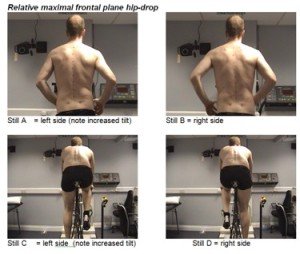
This cyclist had injuries caused by a leg length difference and foot/pelvic asymmetry.
The patient's initial biomechanical assessment confirmed a leg length difference and increased pronation of the left foot. The below gait images confirm this with increased left pelvic tilt (on shorter leg) and increased deviation of left shoe. Observation was supported by 3D analysis which shows that the heel tilts in more on one side than the other.
This graph shows that the left ankle (red line) moves in a downward position excessively to compensate for the leg being shorter on this side. Treatment consisted of orthoses and modification of the cleat to correct the leg length and associated compensations.